Roll-off bins, also known as roll-off containers or dumpsters, are heavy-duty waste and material handling units designed for temporary storage and transportation of bulk solids, demolition debris, construction waste, and recyclables. Unlike fixed-site receptacles, roll-off bins must withstand not only the weight and abrasion of their contents but also the rigors of frequent loading, unloading, transport over uneven terrain, and exposure to weather extremes. Durability in this context is not incidental but engineered through a suite of intentional structural features that collectively resist deformation, corrosion, fatigue, and impact. Understanding these features illuminates how manufacturers enhance service life, reduce maintenance costs, and ensure safe operation across diverse environments.
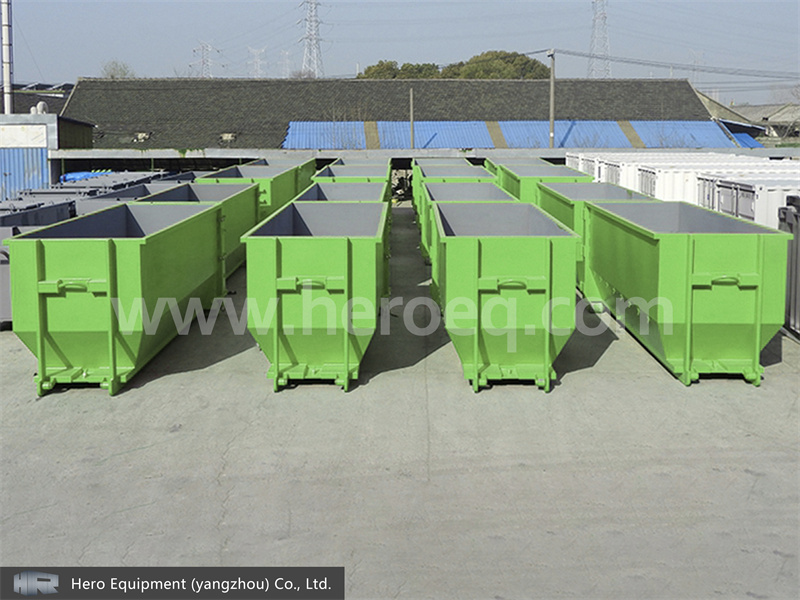
1. Reinforced Corner Post Design
Corner posts are the primary vertical load-bearing members of a roll-off bin, transmitting lifting and towing forces from the hoist hook or truck cable directly into the container structure. In weaker designs, these regions are prone to buckling or tearing under heavy loads or rough handling. High-durability bins employ reinforced corner posts, often formed from thicker gauge steel or specially profiled sections such as hat-shaped or C-channels with internal ribs. Some designs integrate gussets or welded plates at the intersection of corner posts and floor rails to distribute stress concentrations more evenly. By stiffening these critical nodes, the bin resists local failure during hoisting, stacking, or impacts from dropped materials.
2. Continuous Floor Beams and Stringers
The floor of a roll-off bin must support shifting loads that can reach many tons, generating high point loads and distributed pressures. Durable bins use multiple longitudinal stringers—typically heavy-gauge steel channels or formed I-beams—spaced closely beneath the floor sheet to create a continuous load path. These stringers prevent the floor from sagging or puncturing under concentrated weight, and they help distribute load forces to the sidewalls and corner posts. Cross members or transverse beams may tie the longitudinal stringers together, forming a rigid grid that resists torsion and warping during transport. The close spacing and robust section modulus of these floor supports ensure the bin maintains its structural geometry under dynamic loading.
3. Formed and Ribbed Sidewall Panels
Sidewalls are vulnerable to denting, bowing, and perforation from falling debris or collision with equipment. To counter this, durable roll-off bins use formed steel panels rather than flat sheets. Forming techniques such as embossing, corrugating, or adding integral ribs increase panel stiffness without excessive weight gain. These features raise the moment of inertia of the panel, enabling it to resist local buckling and distribute impact energy across a wider area. In some designs, vertical or diagonal stiffeners are welded between the outer skin and inner liner to create a composite action that further enhances rigidity. The result is a sidewall that retains its shape and resists deformation even after repeated heavy impacts.
4. Robust Top Rail and Header Systems
The top rail, running horizontally along the upper edge of the sidewalls, serves multiple protective functions. It shields the top edge of the sidewall panels from direct blows, which could otherwise shear the thin edge or initiate cracks. More importantly, the top rail acts as a structural ring beam, tying the corner posts and sidewalls into a unified frame that resists racking forces during hoisting or side loading. Durable bins feature top rails with increased section depth and thickness, often reinforced with gusset plates welded to the corner posts. In high-capacity or heavy-duty models, double or triple top rail configurations may be used to provide redundancy and prevent collapse of the upper perimeter under extreme load.
5. Integrated Forklift Pockets and Lifting Lugs
Many roll-off bins are handled not only by overhead hoists but also by forklifts for repositioning in confined areas. Durable bins incorporate reinforced forklift pockets—openings in the bottom rails sized to accept standard fork tines—with thickened base plates and bracing to prevent spreading or bending of the pocket under lifting forces. Similarly, lifting lugs or eyes, when specified, are forged or plate-welded attachments with generous cross-sectional area and smooth radii to avoid stress concentrations. These features ensure that the bin can be moved safely by various equipment without deforming the base or compromising structural integrity.
6. Continuous Welds and Seam Design
The integrity of joints largely determines overall durability. Weak or intermittent welds become initiation sites for cracks under cyclic loading or impact. High-quality roll-off bins employ continuous, full-penetration welds along critical seams—corner post to floor rail, sidewall to top rail, and stringer connections. Where access for welding is limited, plug or slot welds may supplement the joint. Manufacturers often specify weld size and profile to meet design load requirements, and some apply weld bead dressing or grinding to remove notches that could encourage fatigue cracking. Seam placement is also strategic: overlapping seams and staggered joint patterns prevent straight-line weaknesses that could propagate under stress.
7. Protective Coatings and Corrosion Resistance
Durability extends beyond mechanical strength to include resistance against environmental degradation. Roll-off bins face rain, snow, road salt, and industrial chemicals that can cause rust and eventual perforation. Durable bins receive robust surface preparation—abrasive blasting to near-white metal—followed by high-build primer and topcoat systems formulated for impact and chemical resistance. Some manufacturers apply powder coating for its thick, uniform coverage and toughness. In aggressive environments, galvanizing or metallizing may be used to provide sacrificial or barrier corrosion protection. These coatings preserve the steel substrate, maintaining both appearance and structural capacity over years of outdoor service.
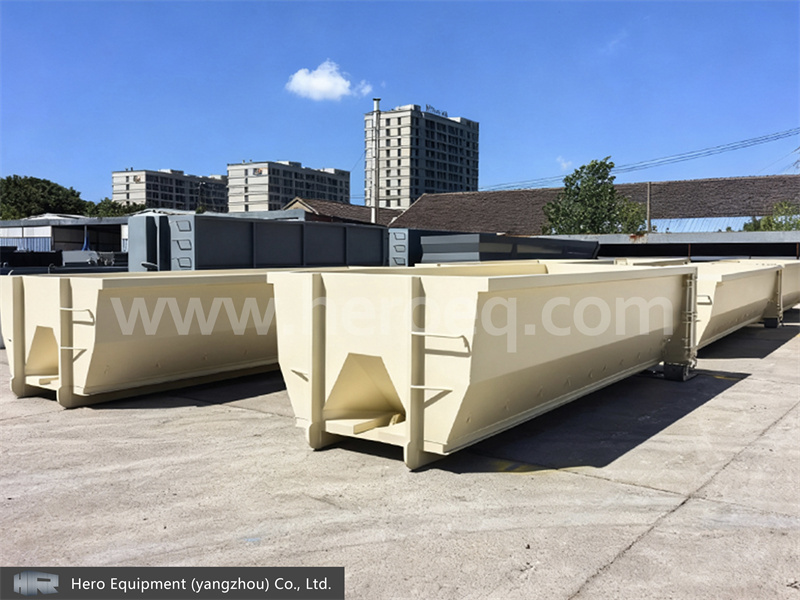
8. Impact-Absorbing Features and Energy Dissipation Geometry
Although steel is inherently stiff, thoughtful geometric design can dissipate impact energy and reduce peak stresses. Sloped sidewall tops or rolled edges deflect falling objects, reducing direct puncture potential. Internal corner fillets and smooth transitions between panels eliminate sharp re-entrant corners where stress concentrates. Some bins incorporate sacrificial wear strips or replaceable liner plates in high-abrasion zones, shielding the main structure from gradual material erosion. These features do not prevent all damage but channel destructive forces away from critical load paths, prolonging structural life.
9. Reinforced Tailgate and Door Assemblies
If the bin includes a tailgate or swing door for loading and unloading, its hinges, latches, and frame must withstand repeated opening, closing, and load-bearing. Durable tailgates use heavy-duty hinge pins supported by reinforced brackets, often with grease fittings for maintenance. The door frame may be boxed or reinforced with diagonal braces to prevent racking. Latches and locking mechanisms are designed for high cycle life and positive engagement, ensuring the door remains secure during transport and does not fail catastrophically under load.
10. Modular and Replaceable Components
A durable design philosophy considers maintainability. Instead of monolithic construction that fails entirely when one part is damaged, high-end bins use modular panels, rails, and hardware that can be individually replaced. This approach localizes damage and reduces downtime. For example, a dented sidewall panel can be unbolted and swapped without discarding the entire bin, preserving the investment and extending usable life.
11. Strategic Material Selection and Gauge Optimization
Durability is also a function of choosing the right steel grade and thickness for each component. High-strength, low-alloy steels may be used in corner posts and floor stringers to provide greater load capacity without excessive weight. In less stressed areas, lighter gauges reduce mass and handling effort. The optimization balances strength, weight, and cost while meeting design safety factors for hoisting, impact, and fatigue.
12. Consideration of Dynamic Load Paths and Hoist Interface
Finally, durability is enhanced by designing the bin as a complete structural system rather than a collection of parts. Engineers analyze dynamic load paths during hoisting, braking, and tipping to ensure forces are carried efficiently to the strongest members. The interface between bin and hoist hardware—often via a standardized lug pattern—is reinforced to prevent local crushing or deformation. This holistic approach minimizes unintended stress risers and ensures predictable performance under real-world service conditions.
The durability of roll-off bins arises from a synergy of structural features that address the unique challenges of heavy-duty material handling. Reinforced corner posts, continuous floor beams, ribbed sidewalls, robust top rails, and strong lifting interfaces form a framework that resists deformation and failure. Continuous welds, protective coatings, and impact-dissipating geometry defend against environmental and mechanical degradation. Modularity and replaceable components extend service life, while optimized material selection ensures strength without unnecessary mass. Together, these features enable roll-off bins to endure the punishing demands of construction sites, recycling centers, and industrial facilities, delivering reliable performance and long-term value.



 โทรศัพท์
ความคิดเห็น
(0)